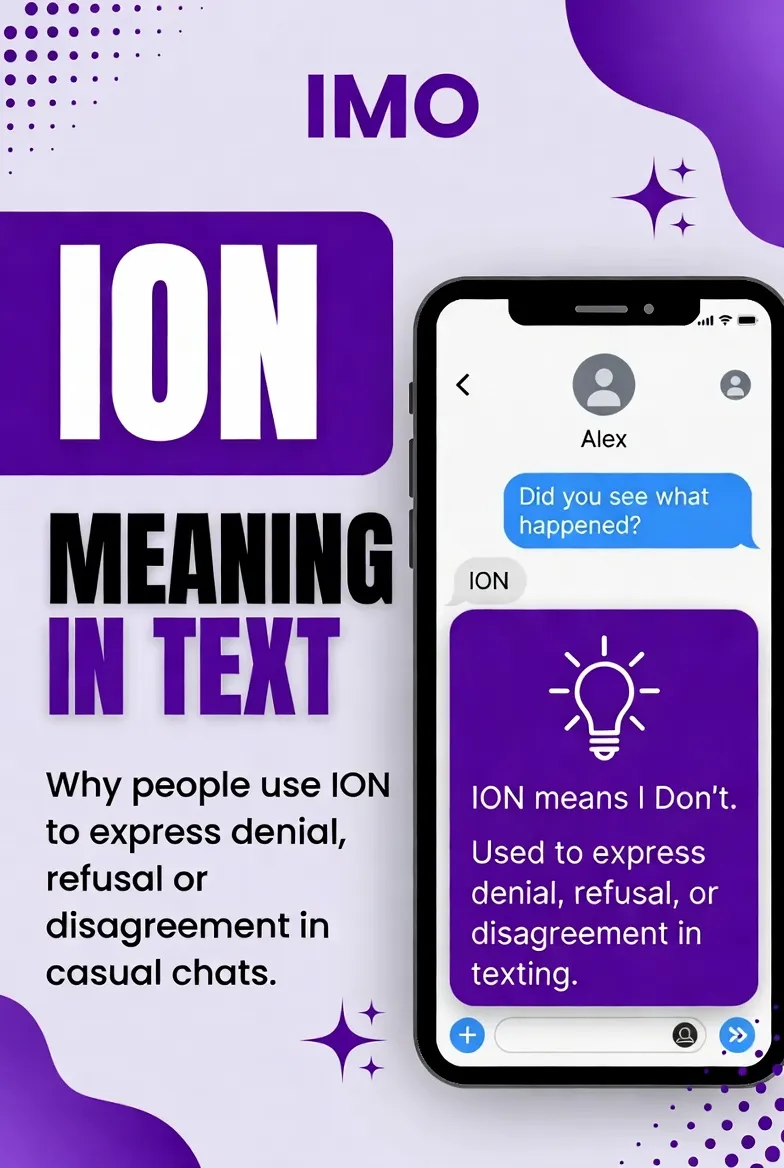

You receive a message that says:
“ION know about that.”
At first glance, the sentence looks strange.
Many people assume ION has something to do with science, chemistry, or atoms. After all, that’s the meaning most of us learn in school. However, in texting and social media conversations, ION often means something completely different.
Internet slang has a way of transforming ordinary words into shortcuts that make conversations faster and more casual. That’s why many people search for “ion meaning in text” after seeing it on TikTok, Snapchat, Instagram, X, or in a group chat.
If you’ve recently come across ION in a message and felt confused, you’re not alone. The good news is that once you understand the context, the meaning becomes much easier to recognize.
ION Meaning in Text
In texting and social media conversations, ION most commonly means “I Don’t.” It is a slang abbreviation people use instead of typing phrases like:
- I don’t know
- I don’t want to
- I don’t think so
- I don’t remember
Examples:
- “ION know.”
- “ION want that.”
- “ION think that’s true.”
- “ION remember.”
The abbreviation comes from the way some people casually pronounce “I don’t” in everyday speech. Over time, that pronunciation became popular in texting and internet slang.
Context is important because ION can also refer to the scientific term “ion” in educational or scientific discussions.
The Most Common Meanings of “ION”
1. ION = I Don’t (Most Common Meaning)
This is the definition most people mean when using ION in text messages and social media.
Instead of writing:
“I don’t know.”
Someone may write:
“ION know.”
Examples:
- “ION feel like going out.”
- “ION think that’s a good idea.”
- “ION remember what happened.”
This version is especially common among younger internet users.
You may be like it:
- HN Meaning in Text: What It Really Means in Messages, Chats
- HMU Meaning in Text: What It Really Means in Messages, Chats
- HM Meaning in Text: What It Really Means in Messages, Chats
- SB Meaning In Text: The Different Ways People Use It In Messages
2. Ion as a Casual Spoken Expression
The slang developed from spoken language.
When people quickly say:
“I don’t know.”
It can sound similar to:
“Ion know.”
That pronunciation eventually became part of internet culture.
Examples:
- “ION got time for that.”
- “ION care.”
- “ION think so.”
3. Ion in Science and Education
Outside texting slang, an ion is a scientific term.
In chemistry, an ion is an atom or molecule that has gained or lost electrons and therefore carries an electrical charge.
Examples:
- Sodium ion
- Chloride ion
- Positive ion
- Negative ion
When discussing science, ION usually keeps its traditional scientific meaning.
Why Do People Use “ION” in Texting?
Faster Typing
It’s shorter than typing full phrases.
Internet Slang Culture
Social media encourages abbreviated communication.
Social Media Influence
Platforms like TikTok and Snapchat helped popularize the term.
Spoken Language Influence
The slang reflects natural speech patterns.
Casual Communication Style
Many users prefer informal texting.
Who Commonly Uses “ION”?
Teenagers & Gen Z
Younger users are among the most frequent users of ION.
TikTok Users
The abbreviation often appears in comments and videos.
Snapchat Users
ION is common in private chats.
X (Twitter) Users
Short-form platforms encourage abbreviations.
Online Communities
Many internet communities use ION naturally.
How “ION” Is Used in Real Conversations
Friends & Casual Chats
Examples:
- “ION know where he went.”
- “ION want to go today.”
Snapchat Conversations
Examples:
- “ION feel like posting.”
- “ION remember sending that.”
TikTok Comments
Examples:
- “ION think that’s true.”
- “ION believe this happened.”
Instagram Messages
Examples:
- “ION know what to say.”
- “ION agree with that.”
Group Chats
Examples:
- “ION think everyone’s coming.”
- “ION got any plans.”
Online Communities
Examples:
- “ION understand the hype.”
- “ION see the problem.”
Examples of “ION” in Sentences
Casual Examples
- “ION know what happened.”
- “ION think that’s right.”
- “ION remember.”
Friendship Examples
- “ION know if he’s coming.”
- “ION got any idea?”
Social Media Examples
- “ION believe this trend.”
- “ION understand why it’s viral.”
Funny Examples
- “ION got enough energy for today 😂.”
- “ION know who approved this.”
Everyday Conversation Examples
- “ION feel like going out.”
- “ION want that.”
- “ION think it’s worth it.”
Difference Between ION and Similar Texting Terms
| Term | Meaning |
| ION | I Don’t |
| IDK | I Don’t Know |
| IDC | I Don’t Care |
| NGL | Not Gonna Lie |
| TBH | To Be Honest |
ION vs IDK
IDK specifically means:
“I don’t know.”
ION can replace many different “I don’t” phrases.
ION vs IDC
IDC means:
“I don’t care.”
ION is broader.
ION vs NGL
NGL introduces honesty.
Example:
“NGL, that’s impressive.”
ION vs TBH
TBH introduces an honest opinion.
Example:
“TBH, I agree.”
Is “ION” Casual, Friendly, or Rude?
Casual Use
Most uses are casual.
Example:
“ION know.”
Friendly Use
Friends often use ION naturally.
Example:
“ION think you’re wrong.”
Humorous Use
The slang frequently appears in jokes and memes.
Example:
“ION got time for this 😂.”
Situations Where It May Sound Dismissive
Depending on tone, ION can sometimes sound blunt.
Example:
“ION care.”
This may come across as rude.
How to Respond When Someone Says “ION”
Casual Replies
- “That’s okay.”
- “Fair enough.”
Friendly Replies
- “Makes sense.”
- “I understand.”
Clarification Replies
- “What do you mean?”
- “Why not?”
Funny Replies
- “You sure about that? 😂”
- “That’s what everyone says.”
Why “ION” Is So Popular Online
Easy to Type
Only three letters communicate an entire phrase.
Reflects Real Speech
The slang mirrors how many people talk.
Social Media Trends
Platforms helped spread the abbreviation rapidly.
Popular Among Younger Users
Gen Z frequently adopts new slang.
Internet Culture Influence
Online communities continually create shorthand expressions.
Common Misunderstandings About “ION”
Thinking It Refers to Science
This is the most common misunderstanding.
Assuming It Is a Technical Term
In texting, it usually has nothing to do with chemistry.
Confusing It With IDK
ION can mean more than simply “I don’t know.”
Ignoring Context
The surrounding conversation usually reveals the intended meaning.
Is “ION” Popular on Social Media in 2026?
TikTok Usage
ION remains common in comments and captions.
Snapchat Usage
The abbreviation frequently appears in private conversations.
Instagram Usage
Users regularly include ION in DMs and comments.
X (Twitter) Conversations
Short-form posts often feature ION.
Online Friend Groups
Many friend groups continue using the term casually.
In 2026, ION remains a recognizable and widely used piece of internet slang.
Similar Internet Slang Terms You Should Know
IDK
I Don’t Know
Example:
“IDK.”
IDC
I Don’t Care
Example:
“IDC what happens.”
NGL
Not Gonna Lie
Example:
“NGL, that’s impressive.”
FR
For Real
Example:
“That’s true fr.”
TBH
To Be Honest
Example:
“TBH, I agree.”
BRB
Be Right Back
Example:
“BRB.”
RN
Right Now
Example:
“Busy rn.”
HMU
Hit Me Up
Example:
“HMU later.”
WYD
What Are You Doing
Example:
“WYD tonight?”
BTW
By The Way
Example:
“BTW, thanks.”
When You Should Avoid Using “ION”
Professional Emails
Professional communication should use complete wording.
Workplace Communication
Not everyone understands internet slang.
Academic Writing
Formal writing should avoid abbreviations like ION.
Formal Discussions
Clear language is usually better.
Business Settings
Professional audiences generally prefer standard English.
Advantages and Disadvantages of Using “ION”
Advantages
- Quick and easy
- Popular in internet culture
- Reflects natural speech
- Common among younger users
- Works well in casual conversations
Disadvantages
- Can confuse readers
- May be mistaken for the scientific term
- Too casual for formal communication
- Not universally understood
How Slang Terms Like ION Are Changing Online Communication
Rise of Spoken-Language Texting
People increasingly type the way they speak.
Social Media Influence
Platforms continuously spread new slang.
Faster Conversations
Short abbreviations make communication quicker.
Informal Messaging Habits
Online communication is becoming more relaxed.
Evolution of Internet Language
Internet slang continues evolving every year.
FAQs
What does ION mean in text?
ION most commonly means “I Don’t.”
Does ION mean “I don’t”?
Yes. In texting and social media slang, that’s usually the intended meaning.
Why do people say ION instead of I don’t?
It comes from casual pronunciation and internet slang culture.
Is ION a slang word?
Yes. ION is a widely used internet slang term.
What does ION mean on TikTok?
It usually means “I Don’t.”
Is ION commonly used on Snapchat?
Yes. It’s frequently used in Snapchat conversations.
Is ION related to science?
Only in scientific discussions. In texting, it usually means “I Don’t.”
Is ION still popular in 2026?
Yes. It remains common across social media platforms.
Should I use ION in professional communication?
No. Standard wording is more appropriate in professional settings.
Final Thoughts
Understanding the ION meaning in text becomes simple once you know the context. In most online conversations, ION stands for “I Don’t” and is commonly used as a shortcut for phrases like “I don’t know,” “I don’t want to,” or “I don’t think so.”
The abbreviation became popular through casual online communication, social media culture, and texting habits that reflect natural speech. While ION can still refer to the scientific term in educational settings, its slang meaning is far more common on platforms like TikTok, Snapchat, Instagram, and X.
The next time you see a message like “ION know,” you’ll immediately understand that it’s just a quick, informal way of saying “I don’t know.”